How a Product Page Redesign Added Incremental Revenue to McNeela’s High-Ticket Instruments
By testing structured, customer-focused PDPs, we unlocked conversion lifts across concertinas, violins, and flutes — adding tens of thousands in profitable growth.
Quick Snapshot
The key highlights for busy readers
The key highlights for busy readers

1. Problem
Many of McNeela’s product pages read like blog posts — walls of text, poorly structured, with no clear flow and no emphasis on addressing key customer objections.
1. Problem
Many of McNeela’s product pages read like blog posts — walls of text, poorly structured, with no clear flow and no emphasis on addressing key customer objections.
1. Problem
Many of McNeela’s product pages read like blog posts — walls of text, poorly structured, with no clear flow and no emphasis on addressing key customer objections.

2. Strategy
I redesigned and tested new Shogun PDPs built around VOC insights, streamlined layouts, objections, and optimized visuals.
2. Strategy
I redesigned and tested new Shogun PDPs built around VOC insights, streamlined layouts, objections, and optimized visuals.
2. Strategy
I redesigned and tested new Shogun PDPs built around VOC insights, streamlined layouts, objections, and optimized visuals.

3. Result
The redesigned pages consistently outperformed legacy versions, delivering meaningful CVR lifts and adding tens of thousands in incremental revenue per SKU.
3. Result
The redesigned pages consistently outperformed legacy versions, delivering meaningful CVR lifts and adding tens of thousands in incremental revenue per SKU.
3. Result
The redesigned pages consistently outperformed legacy versions, delivering meaningful CVR lifts and adding tens of thousands in incremental revenue per SKU.
Inside the Project
How the redesign unfolded
How the redesign unfolded
01
01
The Problem
The Problem
The Problem
When I joined McNeela, many of the product pages looked less like sales pages and more like blog posts. They were text heavy, poorly structured, and overwhelming to customers. Conversion rates on key products were often below one percent, which was especially concerning since most of McNeela’s traffic came from Google Shopping ads and warm audiences who were already looking to buy instruments. Analytics confirmed the problem with a steep drop off between product page and add to cart on several of the most important products.
When I joined McNeela, many of the product pages looked less like sales pages and more like blog posts. They were text heavy, poorly structured, and overwhelming to customers. Conversion rates on key products were often below one percent, which was especially concerning since most of McNeela’s traffic came from Google Shopping ads and warm audiences who were already looking to buy instruments. Analytics confirmed the problem with a steep drop off between product page and add to cart on several of the most important products.
When I joined McNeela, many of the product pages looked less like sales pages and more like blog posts. They were text heavy, poorly structured, and overwhelming to customers. Conversion rates on key products were often below one percent, which was especially concerning since most of McNeela’s traffic came from Google Shopping ads and warm audiences who were already looking to buy instruments. Analytics confirmed the problem with a steep drop off between product page and add to cart on several of the most important products.

02
Customer Insights
Customer Insights
Customer Insights
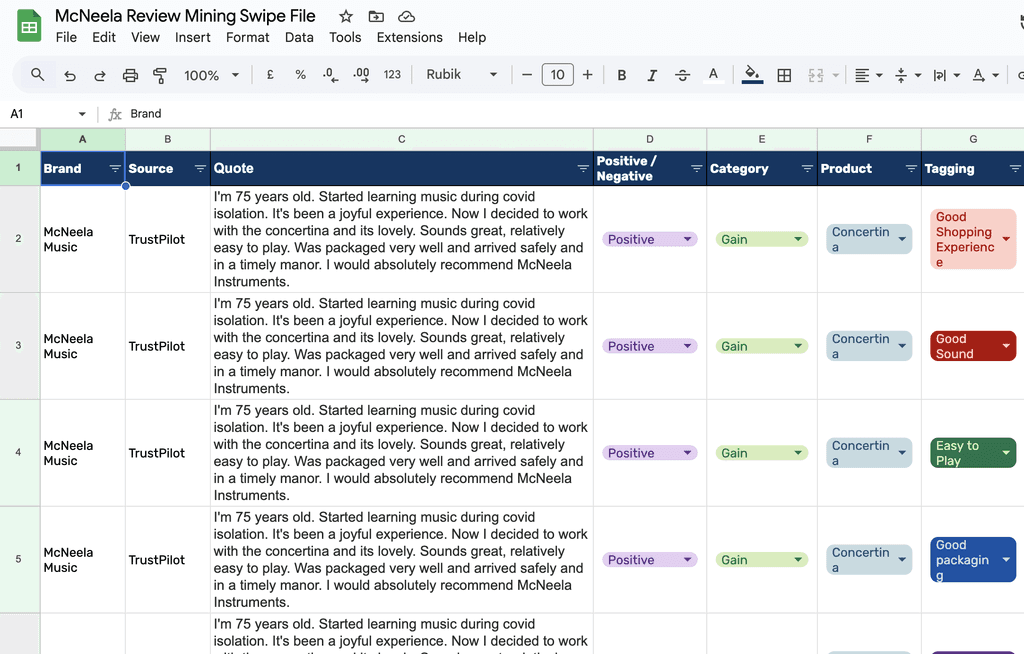
To understand what was driving this underperformance, I dug into customer insights. I reviewed hundreds of product reviews, studied recurring customer service queries, and scraped Reddit forums where musicians discussed their frustrations and buying decisions. Patterns quickly appeared. Beginners worried about ease of learning, advanced players wanted reassurance of durability and tone quality, and nearly everyone was concerned about value and authenticity. These insights became the foundation for how the new pages would be structured.
To understand what was driving this underperformance, I dug into customer insights. I reviewed hundreds of product reviews, studied recurring customer service queries, and scraped Reddit forums where musicians discussed their frustrations and buying decisions. Patterns quickly appeared. Beginners worried about ease of learning, advanced players wanted reassurance of durability and tone quality, and nearly everyone was concerned about value and authenticity. These insights became the foundation for how the new pages would be structured.
To understand what was driving this underperformance, I dug into customer insights. I reviewed hundreds of product reviews, studied recurring customer service queries, and scraped Reddit forums where musicians discussed their frustrations and buying decisions. Patterns quickly appeared. Beginners worried about ease of learning, advanced players wanted reassurance of durability and tone quality, and nearly everyone was concerned about value and authenticity. These insights became the foundation for how the new pages would be structured.
03
The Strategy
The Strategy
The Strategy
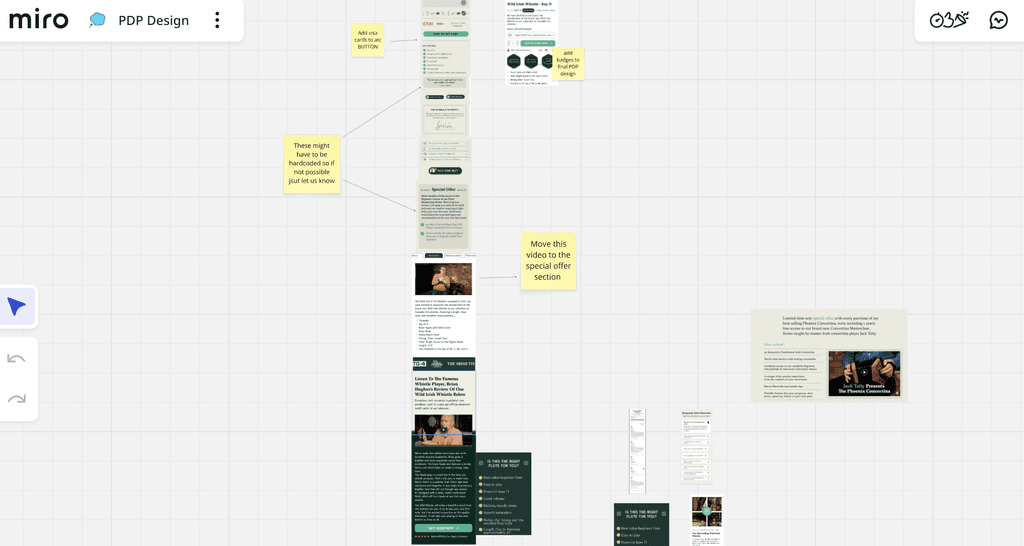
From these insights, I designed a new Shogun template and worked with a designer and developer through multiple iterations. The new structure moved visitors through highlights, benefits, and key objections, with priority information placed higher on the page to counter poor scroll depth. We retook lifestyle images to fit the new layout, focusing on showing answers to common queries, and made add ons like courses, bags, and bundles clearly visible near the top of the page.
From these insights, I designed a new Shogun template and worked with a designer and developer through multiple iterations. The new structure moved visitors through highlights, benefits, and key objections, with priority information placed higher on the page to counter poor scroll depth. We retook lifestyle images to fit the new layout, focusing on showing answers to common queries, and made add ons like courses, bags, and bundles clearly visible near the top of the page.
From these insights, I designed a new Shogun template and worked with a designer and developer through multiple iterations. The new structure moved visitors through highlights, benefits, and key objections, with priority information placed higher on the page to counter poor scroll depth. We retook lifestyle images to fit the new layout, focusing on showing answers to common queries, and made add ons like courses, bags, and bundles clearly visible near the top of the page.

04
Execution at Scale
Execution at Scale
Execution at Scale
Building the template was only the first step. I then rolled it out across more than 150 products in the catalog. This process involved coordinating with the photography and video team to make sure each page had relevant media, embedding demonstrations where possible, and double checking for accuracy and mobile usability. The goal was not only consistency but also clarity so that every product page guided a customer smoothly from consideration to purchase.
Building the template was only the first step. I then rolled it out across more than 150 products in the catalog. This process involved coordinating with the photography and video team to make sure each page had relevant media, embedding demonstrations where possible, and double checking for accuracy and mobile usability. The goal was not only consistency but also clarity so that every product page guided a customer smoothly from consideration to purchase.
Building the template was only the first step. I then rolled it out across more than 150 products in the catalog. This process involved coordinating with the photography and video team to make sure each page had relevant media, embedding demonstrations where possible, and double checking for accuracy and mobile usability. The goal was not only consistency but also clarity so that every product page guided a customer smoothly from consideration to purchase.
05
The Results
The Results
The Results
The redesigned product pages quickly proved more effective. In controlled A B tests, the new template consistently outperformed the legacy versions, producing meaningful lifts in conversion rates across multiple high value products. These incremental gains added tens of thousands in additional revenue per product and also improved customer experience.
The redesigned product pages quickly proved more effective. In controlled A B tests, the new template consistently outperformed the legacy versions, producing meaningful lifts in conversion rates across multiple high value products. These incremental gains added tens of thousands in additional revenue per product and also improved customer experience.
The redesigned product pages quickly proved more effective. In controlled A B tests, the new template consistently outperformed the legacy versions, producing meaningful lifts in conversion rates across multiple high value products. These incremental gains added tens of thousands in additional revenue per product and also improved customer experience.

Key Learnings
This project reinforced the value of constant iteration and testing, but also highlighted how small team dynamics and multiple inputs can slow down even straightforward decisions. Many design changes were debated that did not fundamentally affect conversions, yet still consumed time. Platform constraints also played a role. Because the site was built on BigCommerce with a restrictive theme, we relied on Shogun as the only workable page builder, even though it limited testing options. In hindsight, a different stack and testing setup would have allowed us to prioritize above-the-fold tests. Finally, while much of the customer research process was manual, I now see how AI could streamline review and support ticket analysis to speed up future CRO work.
Still Curious?
Quick answers about the project and process.
How did you know what to test?
How did you know what to test?
How did you know what to test?
What tools did you use?
What tools did you use?
What tools did you use?
What was the hardest part of this project?
What was the hardest part of this project?
What was the hardest part of this project?
What if the redesigns had failed?
What if the redesigns had failed?
What if the redesigns had failed?
Would you do anything differently next time?
Would you do anything differently next time?
Would you do anything differently next time?
Want to Learn More?
Let’s chat about how I can help your brand grow.

Want to Learn More?
Let’s chat about how I can help your brand grow.
Want to Learn More?
Let’s chat about how I can help your brand grow.